en

Search
 English
 日本語
 한국어
 عربى
 Español
 русский
Inquiry Now
Content
Two samples land on the same review table in the same week: a 240 by 260 cm duvet cover in a 200-thread-count cotton percale, and a quilted bedspread with a 45 cm drop on three sides. Both get called a bed top. Both consume fabric, thread, labels and a carton. Yet almost nothing about how they are costed, cut, tested and reordered is the same, and a range built on the wrong one usually shows up six months later as a returns problem rather than a design problem.
So here is the conclusion first. Choose a duvet cover when your customer is really buying a washable shell that sits over a separate insert, when your product page leans on thread count, weave and insert warmth, and when the top layer needs to sell as part of a coordinated set. Choose a bedspread when the customer wants one finished piece that covers the mattress and falls over the sides, when the visual story is quilting and drape, and when the sale must not depend on an insert at all. The duvet cover vs bedspread question is a specification question before it is a styling question, and it changes your bill of materials, your QC checklist and your care label.
This guide is written from the production side, for brand owners, sourcing managers and wholesalers who have to put a number on both options. Nantong Yueluo Home Furnishings has been cutting and sewing quilt cores, pillow cores and bedding sets since 2008, and the questions below are the ones that come up most often when a buyer is deciding which format to put into a range.
A duvet cover is an enclosure. It has an opening, usually a hidden zip, a button placket or a flap closure at the foot end, and it exists to hold a duvet or quilt core inside it. The cover carries the design, the hand feel and most of the washing, while the insert carries the warmth. A bedspread is a completed top layer. It is closed on all four edges, it is frequently quilted or lined, and its job is to cover the mattress and drop down the sides of the bed as one piece.
That single structural difference drives everything downstream. A duvet cover has to be dimensionally matched to an insert that someone else may manufacture, so tolerance control matters more than pattern placement. A bedspread has to be matched to a bed frame and a mattress height, so drop calculation matters more than anything else on the sheet. One is judged on whether it fits the thing inside it. The other is judged on whether it reaches far enough down.
There is also a commercial difference that buyers feel quickly. A duvet cover can be sold as an entry item and then upsold with an insert, a pillowcase pair, a fitted sheet. A bedspread is usually a single-line item with a higher fabric cost per unit and a stronger visual signature on the shelf, which suits buyers who want one strong SKU rather than a layered programme.
| Point of comparison | Duvet cover | Bedspread |
|---|---|---|
| What the customer receives | A removable shell; the insert is bought or sold separately | A single finished top layer, ready to dress the bed |
| Coverage on the bed | Sits mainly on the mattress top; drop is limited by design | Drapes over three sides, often close to the floor |
| Openings and closures | Hidden zip, buttons or flap at the foot end | No opening; closed on all four edges |
| Structure | Usually plain, printed or lightly stitched | Often quilted, padded, lined or matelasse |
| Typical face fabric | Percale, sateen, washed cotton, bamboo blend | Quilted cotton, poly-cotton, jacquard, textured weave |
| Wash rhythm in most homes | Weekly to fortnightly | Weekly to monthly; bulkier in the drum |
| Most common failure mode | Shrinkage after wash, zip failure, size mismatch with the insert | Drop too short, quilting distortion, corner sag |
| Where it wins commercially | Coordinated sets, print stories, insert upsell | Hotel look, quick dressing, one-piece price point |
| Sampling effort | Fit sample against a nominated insert is essential | Bed-frame or drop mock-up is essential |
Neither format is the modern one and neither is the dated one. Both sell, in different channels, to different shoppers, and often in the same brand's catalogue at different price points.
Buyers who have only seen finished samples sometimes assume the two products run through the same line with a small change at the end. In practice the sequence, the operators and the inspection points differ enough that a factory will usually plan them as separate programmes even when they share the same fabric store.
On the factory side, a duvet cover programme is only as good as its fit sample. If the buyer nominates an insert, the sample is built around that insert's measured dimensions after washing, not around the label size. When the dimensions are close but not exact, a 2 cm ease in width and 3 cm in length is often enough to stop the cover looking tight once the insert lofts up.
A useful example of how the two formats produce different products from the same plant: a plain-dyed cotton duvet cover set and a quilted bedspread can both run on the same fabric, but the cover is judged by seam neatness and zip function while the spread is judged by quilting registration and drop consistency. Inspectors look at different things, and the AQL plan should reflect that.
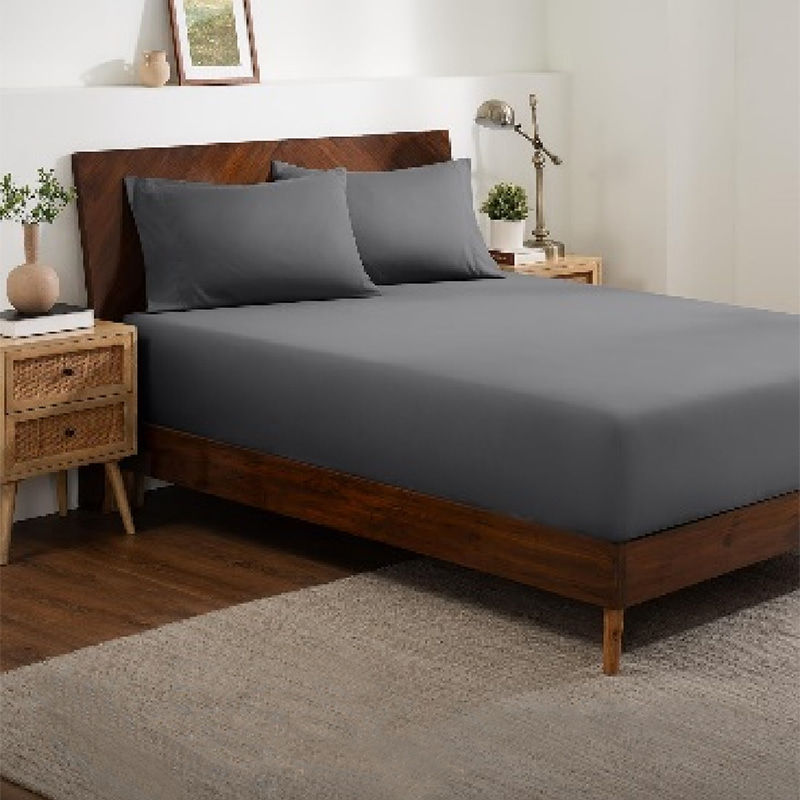
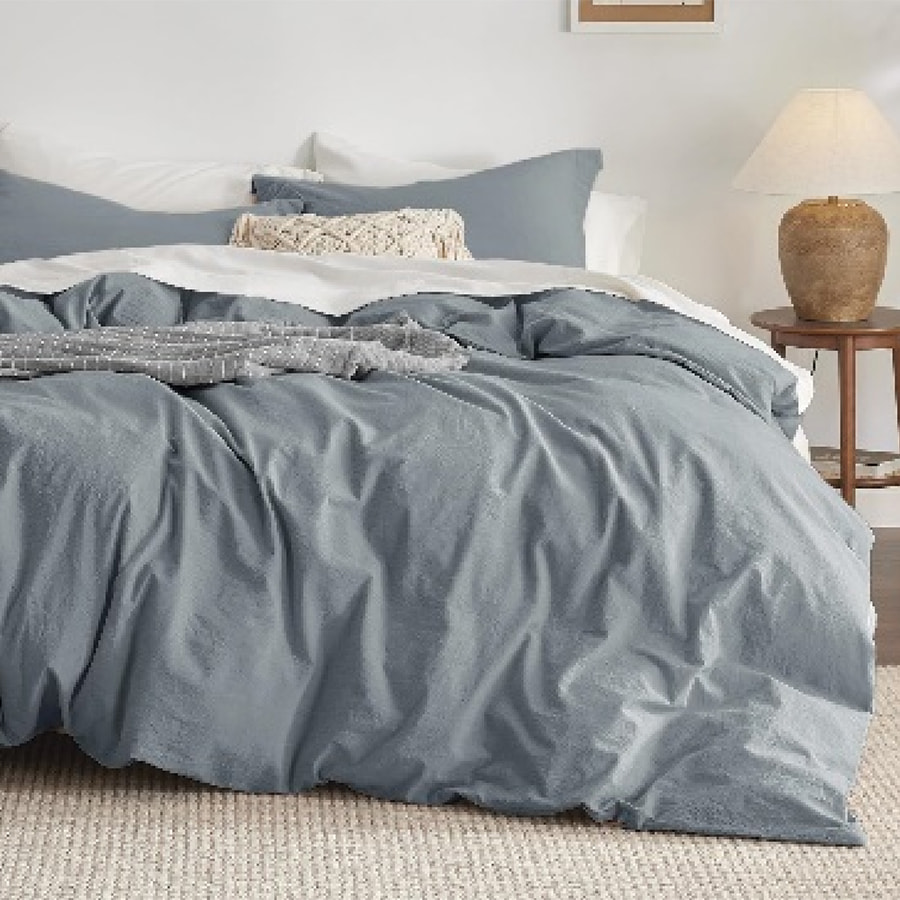 Dyed Pure Cotton Four-Piece Bedding SetA dyed pure cotton four-piece set with washed fabric, zipper closure and corner ties, useful for a duvet cover programme focused on fit and seams.View Product →
For buyers building a first duvet cover programme, a plain-dyed cotton set is usually the lowest-risk starting point: the fabric behaviour is well understood, the shade range is manageable, and the fit conversation stays focused on dimensions rather than on print registration.
Most complaints about either product are sizing complaints dressed up as quality complaints. The customer says the cover is too big, the stitching is poor, the spread is short, the corners lift. Underneath, it is nearly always a dimension that was never pinned down on the purchase order.
Drop is the distance from the top edge of the mattress down the side. Take the mattress height, add the distance from the mattress top to the point where you want the spread to end, and you have your drop. A mattress sitting 30 cm above the frame, with the spread intended to finish 20 cm below the mattress edge, needs roughly a 50 cm drop on both long sides and the foot end. If the buyer wants the spread to reach the floor, the drop is the full mattress height plus the frame height.
The formula that avoids surprises is straightforward: finished width equals mattress width plus twice the drop, and finished length equals mattress length plus the drop at the foot plus any allowance for a pillow tuck. A queen mattress at 152 by 203 cm with a 45 cm drop on three sides lands at about 242 cm wide and 248 cm long. Anything materially narrower will look mean on the bed, regardless of how good the quilting is.
The practical fix is to specify finished dimensions after laundering, not cut dimensions, and to state the tolerance explicitly. A finished-size tolerance of plus or minus 1.5 cm on width and length is workable for most cotton programmes; tighter than that raises the cut rejection rate and the price. Buyers should also state the shrinkage standard being applied, since a cover tested to a domestic wash cycle and one tested to a commercial laundry cycle will not behave the same way.
Bedspread sizing has its own trap: the corners. A square-cornered spread on a standard mattress leaves a gap at the foot, while a rounded or shaped corner follows the mattress better but costs more to cut and bind. Neither choice is wrong, but the decision belongs in the tech pack, not in the factory's default settings.
Talk to a bedding supplier about price and the conversation moves quickly to yield. Two products that look comparable in a photograph can differ by half a metre of fabric per unit, and at container volumes that difference is the margin. Fabric width matters as much as fabric quality here: a 240 cm wide greige cloth lets a duvet cover be cut as two panels with little waste, while a 280 cm width changes the whole cut plan for a bedspread with a generous drop.
The chart below shows indicative consumption for common formats on 240 cm wide fabric. The numbers are planning figures for a normal cut layout, not quotations, and they move once print repeats, nap direction or quilting panels enter the picture.
Read the bars as a rough ranking rather than a price list. A king duvet cover consumes more fabric than a queen bedspread, but it carries no batting, no quilting time and often a simpler packing format, so the two can land at similar factory cost while sitting at very different retail prices. That gap between cost and retail is exactly where buyers should be doing their thinking.
Three levers move the yield more than anything else. The first is fabric width: shifting a bedspread panel from a 240 cm to a 280 cm width can cut waste on drops above 45 cm. The second is panel direction: directional prints and brushed surfaces cannot be rotated, so the cut plan loses flexibility and consumption climbs. The third is shrinkage allowance, which is easy to under-estimate on cheap cotton and expensive to correct after a bulk cut.
Material choice changes more than cost. A 100 percent cotton sateen and a bamboo fibre blend behave differently through washing, pressing and quilting, and the specification should say which one the price is based on. Bamboo blends are often chosen for drape and a cool hand feel in duvet cover sets, and they need slightly different care instructions on the label because of how the fibre responds to heat.
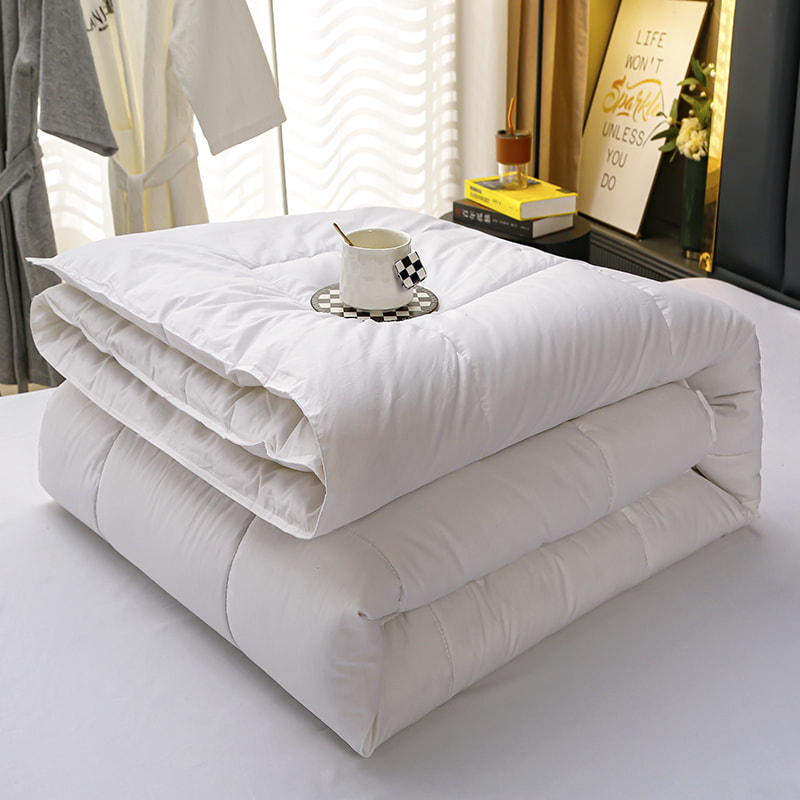 4-Piece Bamboo Fiber Cooling Bedding SetA four-piece bamboo viscose bedding set with cooling, moisture-wicking claims and deep elastic pockets, useful for coordinated cut planning and care-label review.View Product →
A four-piece bamboo fibre set is a good test case for yield planning, because the set bundles a duvet cover, a fitted sheet and pillowcases in one SKU and forces the buyer to think about coordinated cut plans rather than single items.
Customers buy warmth, but they buy it from two different places depending on the format. With a duvet cover, the warmth comes almost entirely from the insert: the cover contributes a few tenths of a tog at most and mainly affects hand feel, breathability and how the bed looks. With a bedspread, the warmth comes from the product itself, through the batting weight, the lining and the amount of air trapped in the quilting.
That has a direct consequence for how you write the product page. A duvet cover listing should talk about the shell: weave, thread count, finish, whether the fabric is pre-shrunk, how the closure works, and which insert sizes it fits. A bedspread listing should talk about coverage: the drop, the quilting density, the batting weight, whether it works over a duvet in winter or alone in summer.
Insulation behaviour in the insert is a topic in its own right, since fill material and construction determine how much warmth a given loft actually delivers, and that in turn decides which cover-and-insert combination you recommend for each climate. Buyers building a winter duvet cover programme usually need a stable insert supply behind it, and this is where a down quilt programme and a cover programme have to be planned together rather than separately.
Breathability is the point where the two formats diverge most in customer perception. A duvet cover over a breathable insert can be adjusted seasonally by changing the insert, which keeps the cover in use all year. A bedspread is a fixed amount of insulation, so a summer version and a winter version are effectively two different SKUs, and buyers who only list one will lose half the year.
A care label is a legal document and a product claim at the same time. For a duvet cover, the label has to describe how the shell behaves after repeated washing, because that is what the customer will actually do to it. For a bedspread, the label has to describe how a bulky quilted item survives a domestic drum, and whether commercial laundering is even possible.
Behind the label sits the test file. Shrinkage after a defined number of cycles, colourfastness to washing and rubbing, seam strength, pilling resistance and, for quilted goods, a check that the batting does not migrate after laundering. Buyers should ask which standard each test was run to, because a result quoted without a method is not a result. Common reference points include the AATCC and ISO laundering methods, and the test report should name the cycle, the temperature and the number of washes.
The commercial laundry question comes up with hospitality buyers. A quilted bedspread that survives domestic washing may not survive a 70 degree commercial cycle repeated weekly, and the quilt stitching is usually the first thing to go. If the end user is a hotel or a serviced apartment operator, say so at sampling stage and specify a suitable filling and stitch density rather than discovering the limit after the first reorder.
Wholesalers and private label buyers rarely fail on product quality alone. They fail on the sequencing between sampling, fabric booking and the retail calendar. A duvet cover programme and a bedspread programme carry different critical paths, and mixing them into one approval date is a common source of delay.
A duvet cover normally needs a proto sample, a fit sample against the nominated insert after washing, and a pre-production sample that matches bulk fabric. A bedspread needs a drop mock-up on a representative mattress, then a quilting registration check, then a pre-production sample. Rushing the fit or drop stage is the single most expensive shortcut in bedding, because a dimension error discovered after bulk cutting is not a repair, it is a re-cut.
Minimum order quantities are usually driven by fabric, not by sewing time. A dyelot minimum in the range of several hundred to over a thousand metres per colour is common for woven cotton, and that number translates into a per-colour, per-size MOQ once the cut plan is applied. Print repeats add a further constraint because the repeat consumes extra metres at the panel ends. Buyers planning a multi-colour range should expect the MOQ conversation to be about colour count as much as about unit count, and should ask early whether a stock-service fabric can reduce the threshold for a test launch.
Lead time follows the same logic. Once fabric is in house and the pre-production sample is approved, sewing and finishing typically run in the region of 30 to 45 days depending on quilting capacity and packing format, with transit on top. The number that matters for a wholesale calendar is the approval date, not the order date.
Seasonality is where the two formats stop competing and start working together. A brand that carries both can keep the same customer through the year without asking them to change their bedding habits.
In warm weather, the duvet cover becomes a light shell over a low-tog insert, or over no insert at all in the hottest weeks, while the bedspread becomes a thin quilted coverlet or a textured cotton layer. Cooling fabrics are usually specified by a touch-feel value, often quoted as a Q-max figure, and buyers should ask for the test method alongside the number rather than accepting a marketing claim. Nylon and spandex blends, polyester and spandex blends and printed cooling constructions each behave differently in the wash, and the care label has to reflect that.
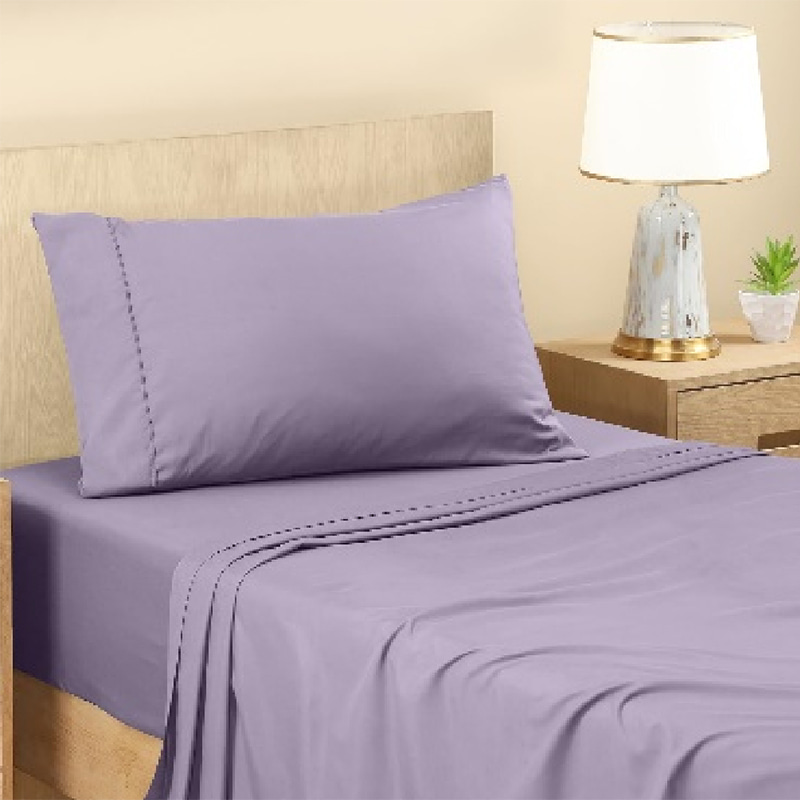 4-Piece Queen-Size Cooling Sheet SetA complete queen-size sheet set with polyester-spandex fitted sheet and pillowcases, offering a cooling summer option for a coordinated bedding programme.View Product →
A four-piece cooling sheet set is a practical way to test a summer story, because it lets the buyer present a complete bed rather than a single item, and it gives the customer a reason to return for the winter programme.
In cool weather, the logic reverses. The duvet cover carries the heavier insert and the brushed or flannel hand feel, while the bedspread becomes the layer that adds warmth and structure on top. Buyers who plan both seasons at once can often share a fabric quality across the range, which simplifies shade approval and reduces the number of dyelots in the calendar.
One caution on colour: seasonal ranges tend to concentrate on a small number of shades, and that concentration is what pushes a project over a dyelot minimum. Planning spring and autumn around a shared base shade is a simple way to keep the MOQ manageable without shrinking the assortment.
When the discussion in the meeting room starts drifting toward personal preference, bring it back to five questions. They take about ten minutes to answer and they settle most of the argument.
Run those five questions against both formats and the answer is usually visible immediately. Where it is not, the underlying problem is normally that the target retail price has not been fixed, and no amount of specification detail will resolve that.
Start with the duvet cover if your customer base is used to buying inserts or already owns one, because the entry price is lower and the product can be expanded into sets. Start with the bedspread if your channel is hospitality, short-let accommodation or a market where one finished layer is the norm. A new brand with no insert supply and a tight budget will usually find the duvet cover easier to launch but harder to convert without an insert partner.
It can be used as a very light top layer in hot weather, but it will look flat and will not provide warmth. Customers who do this often complain that the cover feels thin, which is a positioning problem rather than a quality problem. If you expect this usage, describe the cover explicitly as a lightweight shell and show it styled with a low-loft insert.
Some ranges use the duvet cover as the sleeping layer and the bedspread as the daytime layer, which is common in hotels and in styled interiors. It is a legitimate combination, but it doubles the care instructions and the fabric cost, so it suits buyers with a clear story rather than a broad assortment.
Per square metre of finished product, a bedspread usually carries more cost because of batting, quilting time and edge finishing. Per unit, the comparison depends entirely on size: a king duvet cover can consume more fabric than a queen bedspread. Compare the actual sizes in your range using yield figures rather than comparing the two categories in general.
For an untreated cotton percale or sateen, an allowance of 3 to 5 percent in both directions is a common starting point, with brushed and flannel qualities sometimes moving more. The right approach is to specify the finished dimension after laundering and to test to a named standard, rather than to fix a percentage in isolation. A pre-shrunk fabric will reduce the allowance but adds cost.
For a queen mattress around 152 by 203 cm with a 45 cm drop on three sides, a finished spread of roughly 242 cm wide and 248 cm long will dress the bed properly. If the customer wants the spread to reach the floor, measure the mattress and frame together and add that figure as the drop. Sizes quoted without a drop figure are not comparable across suppliers.
Often yes, and sharing a quality across both products is a sensible way to reduce the number of dyelots in a range. The constraint is construction rather than fabric: a quality that quilts well may be too stiff for a duvet cover, and a very soft sateen may not hold a quilted pattern cleanly. Test both constructions before committing to a shared quality.
Ask for the finished dimensions after laundering, the tolerance, the fabric composition and weight, the shrinkage test method and result, the closure specification, the packing format and the dyelot minimum per colour. Ask also which sample the bulk order will be measured against. A manufacturer who answers all of these in writing is usually a manufacturer worth sampling with.
Two pages on this site go deeper into the points raised above and are worth reading before a specification meeting.
Both are background material rather than a substitute for a specification. The dimensions, tolerances and test methods still have to be written down for your own range.
The duvet cover vs bedspread decision rarely gets settled by a photograph. It gets settled by a short list of facts: what the customer already owns, how often the item will be washed, how far the top layer has to drop, and how much fabric the target price can carry. Get those four written down and the format usually chooses itself, which is a far cheaper way to run a range review than sampling both and hoping the sales data sorts it out later.
For buyers who want to work through the numbers on their own sizes, the practical next step is a specification sheet with finished dimensions, tolerance, fabric weight and shrinkage standard, sent out with a nominated insert or a mattress height. That single document removes most of the ambiguity between a shell and a finished layer, and it gives a bedding manufacturer something concrete to quote against rather than a picture and an idea.
 Zhihao Industrial Park, Chuanjiang Town, Tongzhou District, Nantong, Jiangsu Province
 +86-13814711705
 yueluo800@163.com
Copyright © Nantong Yueluo Home Furnishings Co., Ltd
Rights Reserved.