en

Search
 English
 日本語
日本語 한국어
한국어 عربى
عربى Español
 русский
Inquiry Now
Content
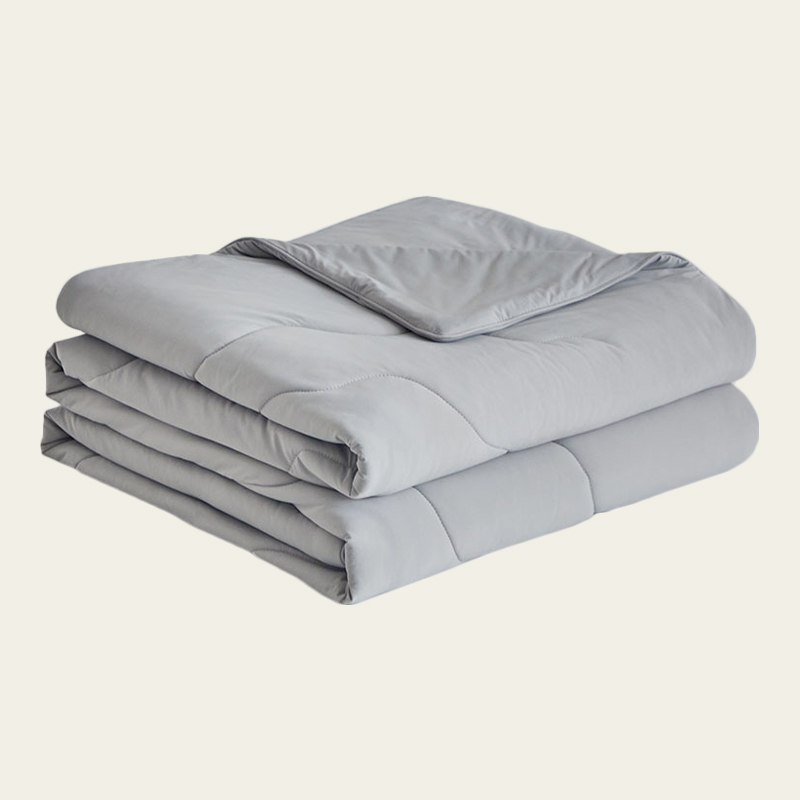
Fill weight refers to the total weight (in grams or ounces) of the insulating material inside the quilt core, excluding the fabric shell. It is the most direct determinant of warmth. For example, a summer quilt core might have a fill weight of 200g (7oz) of down, while a winter version uses 450g (16oz) for the same size. Higher fill weight = more trapped air = better thermal resistance.
Crucially, fill weight differs from "fill power" (loft quality). Fill power measures the fluffiness per ounce, while fill weight measures total mass. A 300g fill weight with 800FP down provides more warmth than a 300g fill weight with 600FP down because the higher loft traps more air. For practical use, always check both numbers.
Thermal insulation is primarily calculated using thermal resistance (R-value) or clo units, derived from material conductivity and thickness. For quilt cores, the standard formula is: Insulation performance = (Fill weight × Fill power) / Surface area + shell fabric adjustment. However, the industry uses two main methods:
A heated manikin wearing the quilt measures the energy required to maintain a constant skin temperature (34°C) in a controlled climate chamber. The result is expressed as a temperature rating (e.g., comfort 5°C, limit 0°C). This accounts for real-world heat loss via conduction and convection.
Use this step-by-step method to estimate warmth without a lab:
For comparison, a summer quilt (R-value ~2.5) works above 15°C, while a winter quilt (R-value ~5.5) handles -5°C. Each additional 50g fill weight (at 700FP) increases R-value by roughly 0.4-0.6.
| Fill weight (g) | Estimated R-value | Comfort temp (°C) |
|---|---|---|
| 200 | 2.2 | +15 |
| 350 | 3.8 | +5 |
| 500 | 5.4 | -5 |
Yes, for the same fill power and construction. But a 300g of 850FP down (warmth index 255,000) can outperform 400g of 550FP down (warmth index 220,000). Always compare fill weight × fill power.
For a standard single quilt core (1.5m²), 450-500g of 700-800FP down or 600-700g of synthetic fill (e.g., Climashield). Synthetic requires 30-40% more weight for equivalent warmth because of lower loft per gram.
Yes, use the Loft Thickness Method: Measure the quilt’s uncompressed thickness (loft) in cm. Estimated comfort temp (°C) = 15 - (Loft cm × 1.5). For example, a 5cm loft → 15 - (5×1.5) = 7.5°C comfort. This works for both down and synthetic, assuming typical density.
Yes, by up to 15%. A windproof shell (e.g., Pertex Endurance) adds +3°C to +5°C effective rating by reducing convective heat loss. Conversely, a highly breathable shell (e.g., 10D nylon) loses warmth in windy conditions. For damp environments, a water-resistant shell prevents fill clumping, preserving insulation.
Down: 10-15 years with proper care. Synthetic: 3-5 years (compression cycles degrade polymers). After 200 nights of use, synthetic loses 20-30% of its loft; down loses only 5-10%. Wash with a dedicated cleaner and store uncompressed to maximise lifespan.
 Zhihao Industrial Park, Chuanjiang Town, Tongzhou District, Nantong, Jiangsu Province
 +86-13814711705
 yueluo800@163.com
Copyright © Nantong Yueluo Home Furnishings Co., Ltd
Rights Reserved.