en

Search
 English
 日本語
 한국어
 عربى
 Español
 русский
Inquiry Now
Content
A sourcing manager sends over a tech pack for a four-piece cotton set and asks one question: can the same construction run for a king? The answer is yes, but not on the same cutting table, and not at the same landed cost. King vs queen bed size is usually framed as a consumer decision, yet most of the real consequences land on the supply side, where a 16-inch difference in width changes fabric consumption, seam placement, carton volume, and how many SKUs a program has to carry.
The short version first. A standard queen mattress measures 60 x 80 inches (152 x 203 cm). A standard king measures 76 x 80 inches (193 x 203 cm). They are exactly the same length. The king is 16 inches wider, which works out to roughly 27 percent more sleeping surface. Everything downstream follows from that single fact: wider flat sheets, wider duvet covers, longer pillowcases, more fill in a quilt, a bigger box, and a different freight calculation.
For anyone buying or manufacturing bedding rather than simply sleeping on it, the useful question is not which size is nicer. It is which size your program can specify accurately, produce consistently, quote without surprises, and stock without dead inventory. That is the question this guide works through, from the tape measure up to the carton.
Nominal mattress dimensions are the starting point for every bedding spec sheet. In the US market, the numbers most retail and brand programs work from look like this.
| Size | Width | Length | Surface area |
|---|---|---|---|
| Twin | 38 in (97 cm) | 75 in (190 cm) | 2,850 sq in |
| Twin XL | 38 in (97 cm) | 80 in (203 cm) | 3,040 sq in |
| Full / Double | 54 in (137 cm) | 75 in (190 cm) | 4,050 sq in |
| Queen | 60 in (152 cm) | 80 in (203 cm) | 4,800 sq in |
| King | 76 in (193 cm) | 80 in (203 cm) | 6,080 sq in |
| California King | 72 in (183 cm) | 84 in (213 cm) | 6,048 sq in |
Two details matter far more than the headline figures. First, queen and king share the same 80-inch length, so a duvet cover, flat sheet, or quilt built for one is usually the right length for the other. Almost all of the adjustment happens in width. Second, mattress dimensions are nominal. A finished mattress can run half an inch to a full inch off spec, and a pillow-top or a two-inch topper effectively turns a queen into something closer to 62 x 82 inches. Fitted sheet pocket depth has to absorb that, not the mattress label.
This is why a workable spec sheet states a mattress height range rather than a single number. We routinely quote fitted sheets with a 35 cm pocket for a 25 to 30 cm mattress, with the elastic and corner construction approved against the tallest end of the range. If a brand sells toppers as an accessory, the pocket depth has to be decided before bulk, not after the first returns arrive.
A 16-inch difference sounds modest in conversation and looks very different on a chart. The visual below places queen and king next to the other common sizes so the jump is easy to judge against the ranges most buyers already know.
Mattress width in inches
Bars are scaled to the 76-inch king width. Length is 80 inches for queen, king, and twin XL, 75 inches for twin and full, and 84 inches for California king.
The gap between queen and king is visibly the largest single step in the standard range, which is exactly why programs tend to bracket it with two separate constructions instead of one stretched pattern. It also explains why the cooling bed kits we produce are tooled around distinct 2-piece double, 3-piece, and 4-piece queen configurations rather than a universal pattern that gets trimmed down. Each configuration is cut to its own finished width, so the fitted sheet corner, the flat sheet hem, and the duvet cover panel all sit where they should.
For a brand planning a range, the chart is also a merchandising tool. If a retail partner already carries full and queen, adding king is a genuine step up in width and price, not a marginal variation. If they carry queen and California king, the two are nearly identical in area but distributed differently, which affects how the bedding is cut far more than how it is displayed.
Sixteen inches of width does not translate into sixteen inches of perceived space. Three effects multiply it. The first is area: 4,800 square inches against 6,080 is a 26.7 percent increase in sleeping surface. The second is perimeter: the queen edge measures 280 inches around, the king 312, an 11 percent increase that shows up as more elastic, more hemming, and more corner handling per unit.
The third effect is personal space, and it is the one customers notice. Split a queen between two adults and each gets 30 inches, which is narrower than a standard single bed. Split a king and each gets 38 inches. Eight extra inches per person changes how much a couple rolls, how often a duvet gets pulled sideways, and how much of a difference a child or a pet climbing in at 2 a.m. actually makes.
There is also a pillow effect that buyers often forget until packaging is designed. A queen program typically ships two standard pillowcases at 20 x 30 inches. A king program usually moves to 20 x 36 inches, and many premium programs substitute euro shams or three-pillow layouts, which changes the piece count and the poly bag dimensions even when the main set construction is unchanged.
Once the mattress size is agreed, the next step is converting it into finished bedding dimensions with clear allowances. A fitted sheet needs enough pocket to clear the mattress plus a topper plus a tuck; a flat sheet needs drop on three sides; a duvet cover needs to match the insert, not the mattress. A typical starting point for US retail looks like the table below.
| Component | Queen | King |
|---|---|---|
| Fitted sheet | 60 x 80 in plus 15 in pocket | 78 x 80 in plus 15 in pocket |
| Flat sheet | 90 x 102 in | 108 x 102 in |
| Duvet cover | 88 to 90 x 92 in | 104 to 106 x 92 in |
| Pillowcase | 20 x 30 in, standard | 20 x 36 in, king |
| Duvet insert | 88 x 92 in | 104 x 92 in |
| Quilt or coverlet | 200 x 230 cm is common | 220 x 240 cm is common |
Notice that the fitted sheet for a king is usually specified at 78 inches rather than 76. The extra two inches are not slack; they are there so the sheet can be pulled over the corners without stretching the elastic to its limit on the first wash. Programs that specify a true 76-inch fitted sheet tend to see corner pop-off complaints within weeks.
Flat sheet drop is the other number worth arguing about early. A 90-inch flat sheet on a 60-inch queen gives 15 inches of drop per side, which tucks comfortably. A 108-inch flat sheet on a 76-inch king gives 16 inches per side, in the same range. The relationship is deliberately similar; the absolute numbers are not.
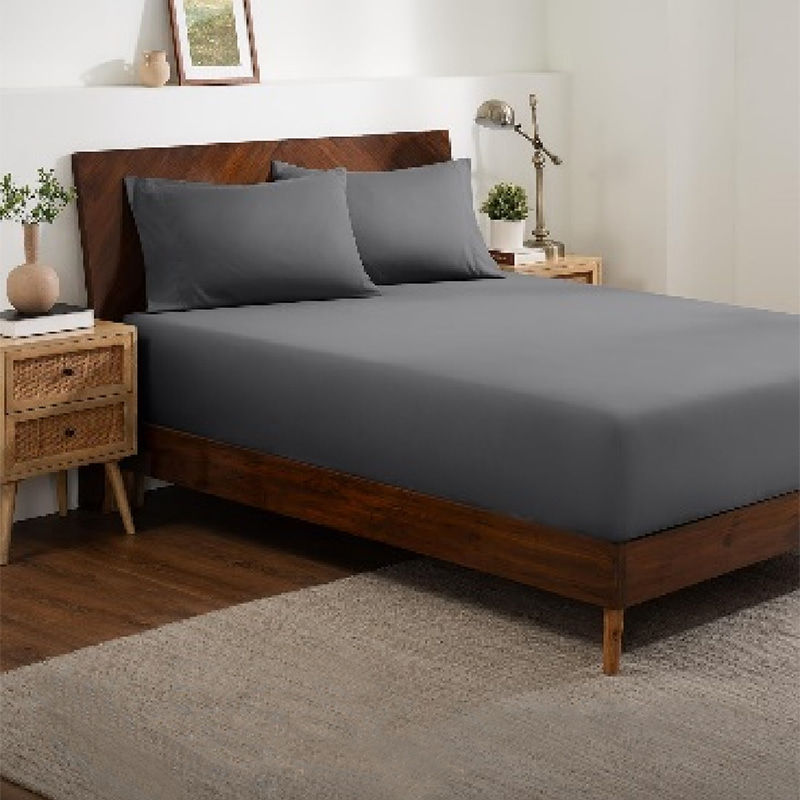
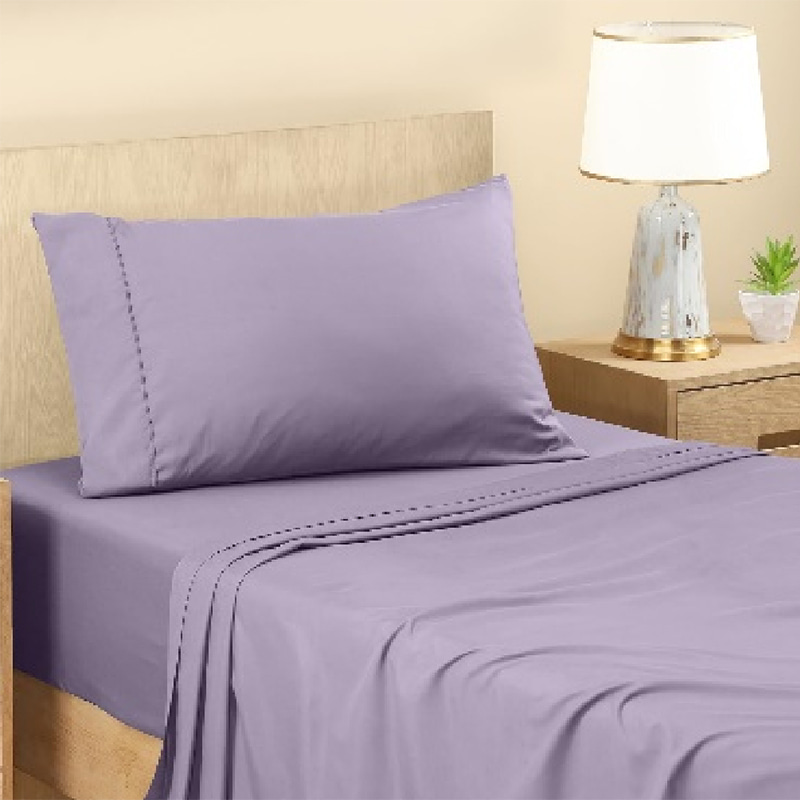 4-Piece Queen Cooling Sheet Set in Solid ColorsQueen-specific four-piece set with flat sheet, fitted sheet, and two pillowcases, using microfiber polyester and spandex for breathable, shrink-resistant bedding.View Product →
This is how our own size development work is structured. The 4-piece queen cooling sheet set is built to a queen specification from the pattern stage rather than adapted from a double, which keeps the fitted corner geometry and the flat sheet drop consistent across production lots. For brands extending into king, the same construction is re-cut to the wider panel instead of being scaled by percentage, because percentage scaling breaks corner fit long before it breaks the visual proportions.
Most export bedding is cut from greige or finished fabric in 240 cm, 250 cm, or 280 cm widths. That single detail decides whether a king duvet cover can be cut as one panel and whether the quoted price holds after the first bulk run. A king duvet cover at 104 to 106 inches wide is roughly 264 to 270 cm. On 240 cm fabric it cannot be cut in one piece. It has to be pieced, usually with a centre or off-centre join, or moved to wider fabric at a higher price per metre.
Queen sits on the other side of that line. A queen duvet cover at 88 to 90 inches is about 224 to 229 cm, which fits inside 240 cm with a small margin for seam allowance and shrinkage. The practical consequence is that a program can quote queen and king on the same fabric quality and still see a meaningful cost difference per set, because the king either consumes wider fabric or consumes more labour for the join.
Rough consumption figures for a plain-dyed cotton four-piece set on 240 cm fabric sit around 7 to 8 metres for a queen and 8.5 to 10 metres for a king, depending on pocket depth, cuff style, and whether pillowcases are cut two-up. That is a 15 to 25 percent increase in material per set before any consideration of wider fabric. On a 5,000-set program, the difference in fabric commitment is not a rounding error.
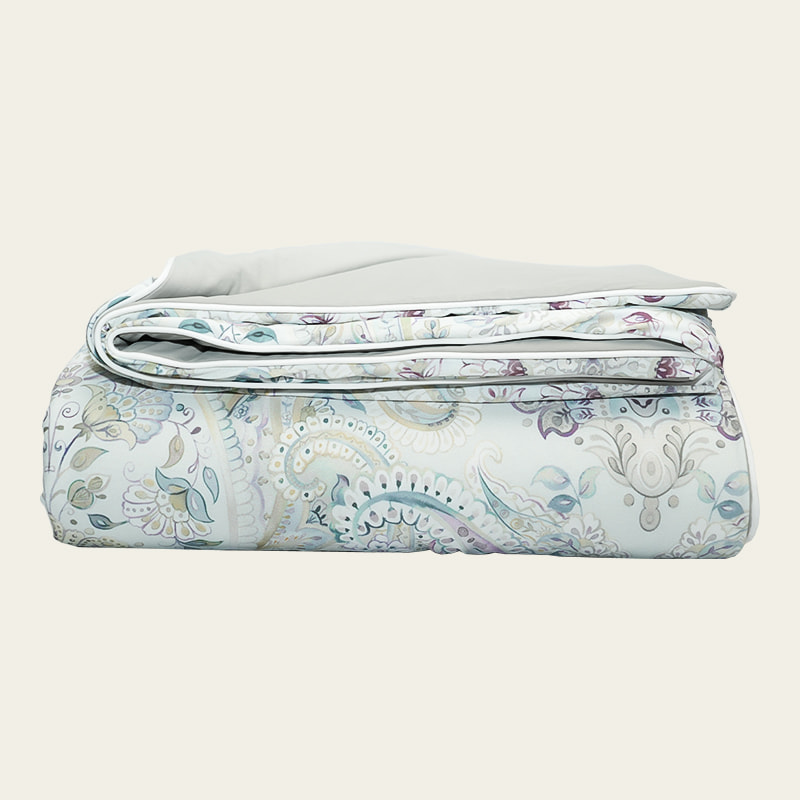
 Dyed Pure Cotton Four-Piece Bed SetPure cotton four-piece set with duvet cover, fitted sheet, and two pillowcases, pre-washed for softness and featuring a subtle two-color yarn-dyed look.View Product →
Cutting efficiency matters as much as raw consumption. Pillowcases nest well against flat sheet panels, and a layout that pairs queen flat sheets with standard pillowcases wastes less than one that pairs king flat sheets with king pillowcases on the same marker. Factories that quote from a marker rather than from a consumption table tend to be more accurate on mixed-size orders, which is one reason our dyed cotton bedding sets are quoted per size rather than per average.
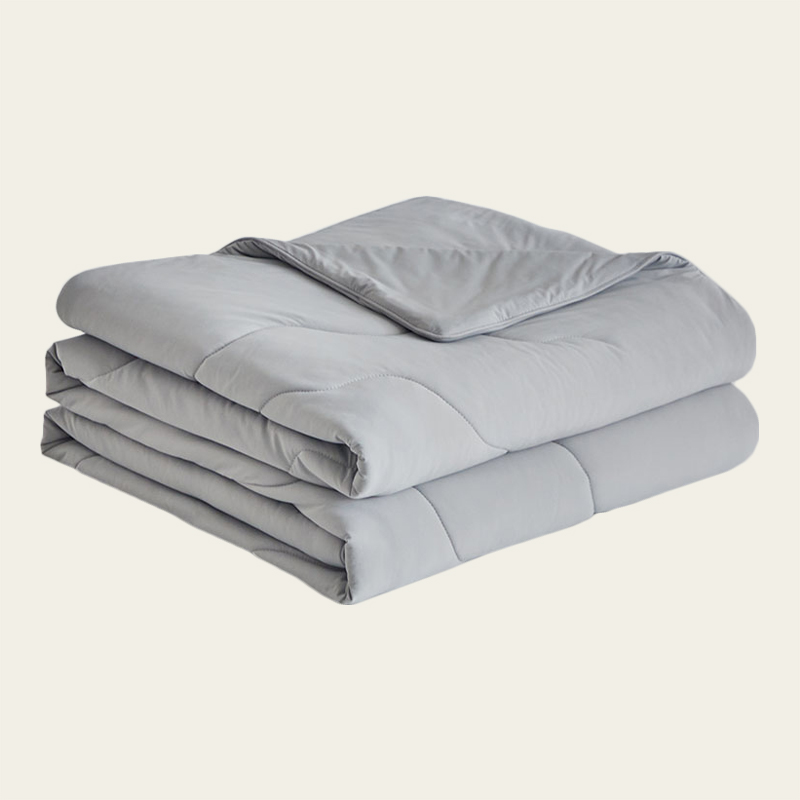
Quilt sizing is where queen and king programs diverge most often, and usually silently. Two numbers get confused: the size printed on the label and the drop on the finished bed. Drop is simply half the difference between quilt width and mattress width, and it determines whether a quilt looks generous or stingy regardless of what the packaging claims.
Take a 220 x 240 cm quilt on a 193 cm wide king. The drop per side is about 13.5 cm, which is enough to cover the mattress and not much more. Put the same quilt on a 152 cm queen and the drop is 24 cm per side, a visibly fuller look. The same product photographed on a queen and a king will read as two different qualities, even though the fabric, fill, and stitching are identical.
For a proper king presentation, a 240 x 260 cm quilt or a 240 x 240 cm coverlet gives closer to 23 to 24 cm of drop per side. That is a large enough panel that fill distribution and quilting density have to be re-checked, because a wider quilt with the same fill weight per square metre carries more total grams and behaves differently on the machine.
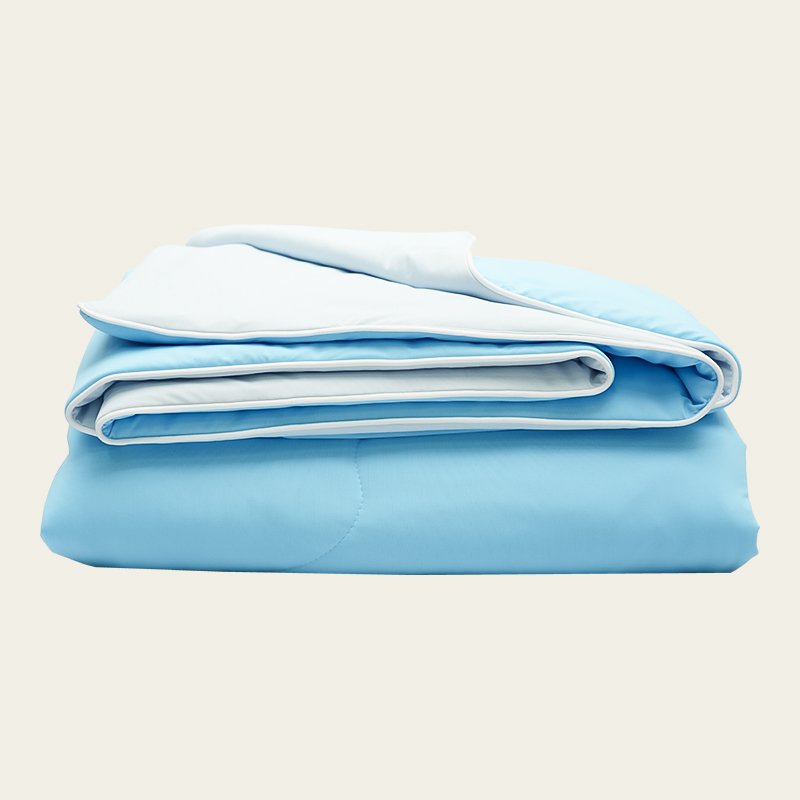
 Single-Size Duck Down Quilt with Baffle-Box ConstructionSingle 168 x 223 cm quilt filled with 250gsm duck down and feather blend, using baffle-box construction and eight corner buckles for secure duvet coverage.View Product →
Fill weight planning follows the same logic. If a queen quilt at a given gram per square metre uses one fill load, the king equivalent uses roughly a quarter more. Programs that hold fill weight constant and only change dimensions will find the king quilt heavier and warmer in use, which may or may not be the intent. Where the intent is a consistent thermal feel, fill weight per square metre stays fixed and total grams scale with area.
Bed size decisions are constrained by the room long before they reach the factory. As a working rule, a queen needs a room of at least 10 x 10 feet (about 3 x 3 metres) to leave usable walking space, and a king needs closer to 12 x 12 feet (about 3.65 x 3.65 metres). Below those figures the bed fits, but the room stops functioning: wardrobe doors foul the corner, and there is no comfortable path around the foot.
A more reliable check is clearance rather than floor area. Allow 24 to 30 inches of walking space on the sides a person actually uses, plus 18 to 24 inches for a nightstand. A king at 76 inches wide plus two nightstands leaves very little in a 12-foot room, which is why many buyers who want king width end up choosing a platform base without a surrounding frame.
For brands and retailers, this has a merchandising consequence. A king display consumes noticeably more floor space than a queen display and shows fewer full room sets per square metre of shop floor. Many stores display queen and sell king from a size chart and a swatch, which is efficient but puts more weight on the accuracy of the size chart. If the chart on the wall is wrong by three inches, the customer discovers it at home.
The 30-inches-per-person rule is a good first filter. Two adults on a queen get 30 inches each, which is fine for quiet sleepers and cramped for anyone who moves. Two adults on a king get 38 inches each, which is the same as a generous single bed per person. Couples who report being woken by each other usually improve more from 16 extra inches of width than from any change in filling or fabric.
Height matters as much as width, and it is where the king and California king get confused. Both standard sizes are 80 inches long, which suits most sleepers up to roughly 6 feet 2 inches. Above that, the feet start pressing into the footboard or hanging over, and the California king at 84 inches is the more sensible answer, at the cost of 4 inches of width compared with a standard king.
Single sleepers get less out of the upgrade. One adult on a queen has 60 inches, more than a twin and a half. A king typically buys floor space and visual impact rather than functional sleeping area, and the extra bedding cost and laundry volume are real. Where a king is chosen for children who co-sleep or for pets, the practical benefit is genuine and worth the cost.
Export programs run into trouble because the word queen is not internationally consistent. A buyer in London asking for a king may be describing a mattress almost identical to a US queen, and a buyer in Sydney asking for a queen may be describing something a US customer would call a king. Writing the size name into a purchase order without the centimetres attached is how two lots end up incompatible.
| Market | Size closest to a US queen | Size closest to a US king |
|---|---|---|
| United States | Queen, 152 x 203 cm | King, 193 x 203 cm |
| United Kingdom | King, 150 x 200 cm | Super king, 180 x 200 cm |
| Continental Europe | 160 x 200 cm | 180 x 200 cm |
| Australia | Queen, 153 x 203 cm | King, 183 x 203 cm |
| China (domestic) | 150 x 200 cm | 180 x 200 cm |
The takeaway is not that size names are unreliable. It is that size names are labels and centimetres are specifications. A UK king at 150 x 200 cm is within 2 cm of a US queen, so a bedding set cut for one will almost fit the other, but almost is not a specification. A UK super king at 180 x 200 cm is 13 cm narrower than a US king, which is enough to change the flat sheet drop noticeably.
For brands selling across regions, the practical answer is one pattern family and several size variants, each with its own approved finished dimensions. Trying to serve the US, UK, and EU markets from a single "king" pattern produces a set that is slightly wrong everywhere, and slightly wrong is the hardest kind of complaint to defend against.
Most size-related problems in bedding programs are not design failures. They are specification gaps that only become visible once hundreds of sets are in a warehouse. These are the ones that come up most often when a brand moves from a sample to a full run.
Each of these is inexpensive to fix at the sampling stage and expensive to fix afterwards. The pattern is consistent: the earlier a size is pinned down in centimetres with tolerances attached, the fewer surprises survive to bulk.
When a brand sends a queen sample and asks for a king counterpart, a short checklist keeps the conversation from drifting. Each item below has caused a revision at some point, usually because it was assumed rather than written down.
None of these items is complicated. What makes them work is being settled before the first cutting ticket is issued, because cutting is where a size decision stops being flexible. A brand that finalises queen and king dimensions at the sampling stage usually needs one round of revisions; a brand that finalises them after the first bulk delivery usually needs a new pattern.
A standard king is 16 inches (about 41 cm) wider than a standard queen and exactly the same length at 80 inches. In terms of surface area that is roughly 26.7 percent more sleeping surface, and about 11 percent more perimeter to finish and elasticate. The width difference is the entire story; length is unchanged.
No, not properly. A queen flat sheet at around 90 inches wide gives 7 inches of drop per side on a 76-inch king, which leaves the sides of the mattress exposed. A queen fitted sheet cannot stretch over 76 inches of width without tearing or popping off at the corners. Duvet covers show the gap even more clearly.
For US sizing, 104 to 106 inches wide by 92 inches long (roughly 264 to 270 cm by 234 cm) matches a standard king insert. The metric size commonly exported as 220 x 240 cm is better suited to a 180 cm wide mattress, so on a 193 cm king it gives only about 13.5 cm of drop per side. Check the drop target before approving the size.
Practically, yes. A queen works in a room of about 10 x 10 feet, while a king generally needs closer to 12 x 12 feet to keep usable walking space. The stricter test is clearance: allow 24 to 30 inches on the sides people walk on, and remember that nightstands consume width that the mattress does not.
For a plain-dyed four-piece cotton set on 240 cm fabric, expect roughly 8.5 to 10 metres for a king against 7 to 8 metres for a queen, an increase of 15 to 25 percent. If the king duvet cover exceeds the fabric width and has to be pieced, add labour and a possible switch to 280 cm fabric on top of that.
Launching queen first lowers the initial fabric commitment and validates the construction, but adding king later usually means a second sampling round and a second dye lot. Where the retail partner has confirmed demand for both, running queen and king together in one production window is generally cleaner for colour continuity, even though it raises the opening order value.
A practical starting point is plus or minus 2 percent on finished dimensions measured after three home launderings, and plus or minus 3 percent on fill weight per square metre. Tighter tolerances are achievable on woven cotton but raise the reject rate, and the cost of that reject rate has to be priced into the quotation rather than absorbed later.
No. A California king is 72 x 84 inches, so it is 4 inches narrower and 4 inches longer than a standard king. The two have almost identical surface area but completely different proportions, which means separate patterns and separate bedding specifications rather than a shared one.
Nantong Yueluo Home Furnishings has been producing quilt cores, pillow cores, and bedding sets since 2008, and the pattern across those years is consistent: the programs that run smoothly are the ones that settled their size logic before sampling. Brands that arrive with centimetres, a mattress height range, a drop target, and a fill weight per square metre tend to move from approved sample to bulk delivery without a size revision. Brands that arrive with a size name and a photograph usually need two rounds.
The company operates in-house product technology and design development centres, which means a queen-to-king extension can be worked through as a pattern and specification exercise rather than a guess. Custom development is handled from customer drawings or physical samples, and inquiries are answered within one working day. For buyers comparing a wholesale bedding supplier on price alone, the more useful comparison is usually on specification discipline, because a set that fits properly the first time costs less across a season than one that is re-cut twice.
If you are planning a queen and king range across cooling quilts, down quilts, pillow cores, or cotton and bamboo bedding sets, the fastest route is to send the dimensions you intend to sell, not the dimensions you assume. That single step removes most of the difference between a quote that holds and a quote that gets renegotiated after the first container.
Useful next reading
 Zhihao Industrial Park, Chuanjiang Town, Tongzhou District, Nantong, Jiangsu Province
 +86-13814711705
 yueluo800@163.com
Copyright © Nantong Yueluo Home Furnishings Co., Ltd
Rights Reserved.