en

Search
 English
 日本語
日本語 한국어
한국어 عربى
عربى Español
 русский
Inquiry Now
Content
The direct answer: clean your printed cooling quilt by machine washing in cold water on a gentle cycle, separately from other garments, tumble drying on low heat, and never bleaching. Following these steps preserves both the vibrant botanical and floral print colors and the cool-touch performance of the fabric across many washes. This guide goes further — explaining why each step matters, what to avoid, how different fabric types respond to washing, and how to store your summer quilt between seasons for maximum longevity.
A printed quilt is fundamentally different from a plain-colored one in one critical respect: the surface carries a layer of dye or pigment-based ink that binds to the fabric fibers during the printing process. For quilts printed with botanical floral patterns or cartoon designs, the print layer must remain intact wash after wash — otherwise colors fade, bleed, or crack, destroying the visual appeal that made the quilt attractive in the first place.
At the same time, cooling bedding relies on specific fabric engineering — typically ultra-fine synthetic or blended fibers that enable rapid heat dissipation and moisture transport. Aggressive washing (high water temperatures, harsh detergents, vigorous agitation) can degrade these fiber structures, reducing the quilt's breathability and cool-touch performance over time. This dual requirement — protecting the print and preserving the cooling function — is why a tailored care approach matters more for a cooling comforter than for ordinary bedding.
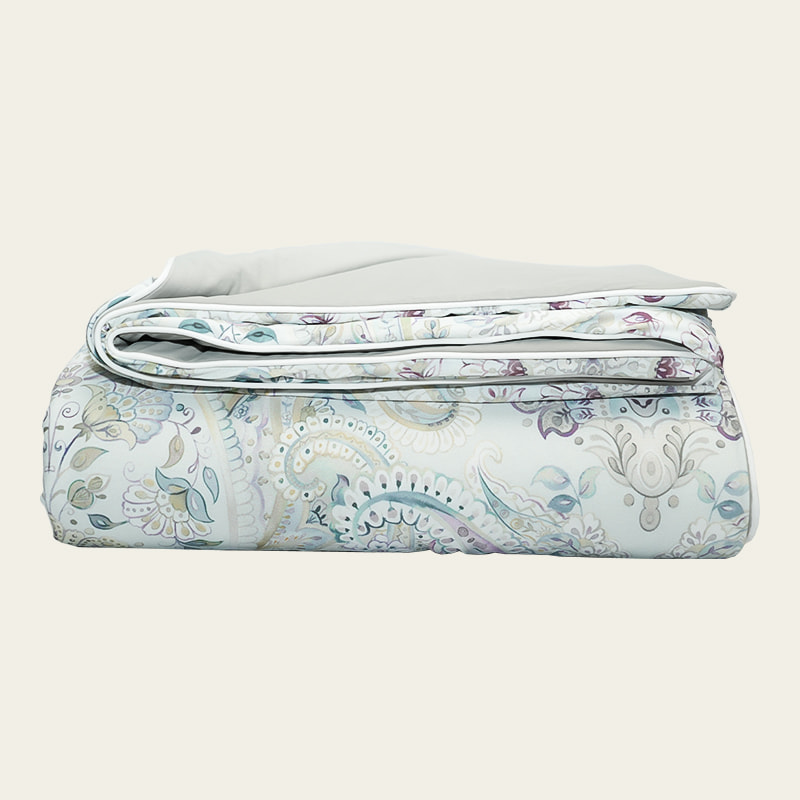
The Yueluo Printed Cooling Quilt uses an ultra-fine soft cool fabric shell that is skin-friendly and lightweight. Its double-sided design — with different patterns on each face — means both surfaces are printed, doubling the importance of correct washing technique. Fortunately, with the right method, the quilt remains soft, vibrant, and thermally effective even after multiple washes.
Following a consistent washing routine is the single most effective way to extend the life of your summer bedding. The steps below are ordered by importance — skipping any one of them can lead to color loss, fabric damage, or reduced cooling performance.
Always wash your printed quilt separately from garments of different colors, especially on the first few washes when dye release is highest. Even high-quality print dyes can release a small amount of color during the initial wash cycles. Washing the quilt with white or light-colored items in the same load risks staining those items. Sort with similar colors only — for example, wash a floral-printed bedroom quilt with other similarly-toned items if co-washing is necessary.
Set your washing machine to cold water (below 30°C / 86°F) and choose the gentle or delicate cycle. Cold water serves two functions: it minimizes dye migration by reducing the thermal energy that causes dye molecules to loosen from fabric fibers, and it protects the fine synthetic fibers in the cooling fabric from heat-induced stress. The gentle cycle reduces mechanical agitation, which prevents pilling on the quilt's surface and maintains the smooth, cloud-like texture that defines a quality lightweight quilt.
Choose a mild liquid detergent labeled "color-safe" or "gentle formula." Avoid powder detergents, which can leave residue in quilt fill or on printed surfaces. Never use chlorine bleach or oxygen bleach — even diluted bleach causes irreversible pigment breakdown in printed fabrics, turning vibrant botanical patterns pale and patchy. Use only the recommended detergent quantity; excess detergent does not improve cleaning and is harder to rinse out of a bulky cooling blanket, potentially leaving a film that reduces breathability.
After washing, tumble dry the quilt at low temperature — typically the "low heat" or "air dry" setting on your dryer. High heat is the most common cause of shrinkage, elastic fiber damage, and print cracking in printed cooling quilts. Remove the quilt while slightly damp and lay it flat or hang it in a shaded area to complete drying. Direct sunlight, while effective for drying, causes UV-induced fading of printed colors and should be avoided for printed quilts with vibrant pigment designs.
Ironing a printed cooling quilt — especially on the printed surface — can melt the binder in the print layer, causing permanent smearing or cracking of the pattern. Dry cleaning solvents can similarly damage synthetic cooling fibers and printed surfaces. The Yueluo cooling quilt is designed to be fully machine-washable without requiring either of these treatments, making it a genuinely low-maintenance choice for year-round summer bedding.
One of the most common concerns buyers have about a printed cooling quilt is whether repeated washing degrades either the print quality or the cooling function. The horizontal bar chart below compares estimated print vibrancy retention and cooling performance retention across different washing scenarios — correct care vs. incorrect care (hot water, no laundry bag, harsh detergent).
The data shows a dramatic divergence between correct and incorrect care approaches after just 20 washes. With proper cold-water gentle-cycle washing, print vibrancy is retained at approximately 91% and cooling performance at 88% after 50 wash cycles. In contrast, hot-water machine washing with standard detergent causes print vibrancy to drop to roughly 54% and cooling performance to degrade to around 61% at the same wash count. The lesson is clear: the quilt's longevity is almost entirely determined by adherence to the washing instructions.
This is particularly relevant for hot sleepers who may wash their summer blanket more frequently than average users — weekly washing during peak summer months can accumulate 20+ cycles in a single season. For this user group, consistently correct washing habits aren't optional; they're essential to maintaining the quilt as a functional cooling bedding item across multiple seasons rather than just one.
It is also worth noting that the double-sided design of the Yueluo printed quilt offers a practical benefit for longevity: rotating which side faces outward each wash cycle distributes wear evenly across both printed surfaces, reducing the concentration of mechanical stress on either face. This simple habit, combined with proper washing, can meaningfully extend the visual lifespan of the floral or cartoon print pattern.
Chart 1: Estimated retention rates after 50 wash cycles — correct care (cold/gentle) vs incorrect care (hot/standard)
The line chart below tracks estimated print color vibrancy over 60 wash cycles for three washing approaches: cold water gentle cycle (recommended), warm water standard cycle (30–40°C), and hot water standard cycle (60°C+). The vertical axis represents color vibrancy as a percentage of the original print, measured using a standardized visual comparison scale used in textile quality testing. Understanding this trajectory helps users make informed decisions about how they launder their printed cooling quilt.
The cold-water curve shows the flattest trajectory, indicating minimal color loss across the entire wash lifecycle. Even at 60 cycles, vibrancy is estimated at around 90%, meaning the botanical floral or cartoon print retains nearly its original appearance. The warm-water curve shows moderate degradation, reaching approximately 72% vibrancy at 60 washes — noticeable but not dramatic. The hot-water curve, however, drops sharply: by wash 20 the print has already lost roughly 25% of its vibrancy, and by wash 60 it sits at around 48%, at which point patterns that were once vibrant appear dull and washed-out.
For users who value the aesthetic dimension of their bedroom quilt — the vibrant floral patterns, the cartoon designs, the double-sided versatility — cold water washing is non-negotiable. The visual appeal of a printed summer quilt is part of its value proposition as a room-brightening, style-forward bedding choice, and that appeal is directly maintained or destroyed by wash temperature choices.
An additional consideration: the vibrancy data above assumes no bleach use. Chlorine bleach applied even once to a printed cooling quilt can cause immediate, dramatic color stripping — in some cases removing 40–60% of print vibrancy in a single wash event. Once bleach damage occurs, it cannot be reversed. This is why the Yueluo care instruction specifically prohibits bleaching, and why this single rule deserves the most emphasis for anyone cleaning a printed quilt for the first time.
Chart 2: Estimated print color vibrancy retention across 60 wash cycles by water temperature
For quick reference, the table below summarizes the correct and incorrect care actions for a printed cooling quilt. This serves as a practical checklist before each wash, particularly useful for first-time owners of cooling bedding who may be accustomed to simpler cotton quilt care routines.
| Care Dimension | Do This | Avoid This |
|---|---|---|
| Water Temperature | Cold water (below 30°C) | Hot water (above 40°C) |
| Wash Cycle | Gentle / Delicate cycle | Heavy-duty / Cotton cycle |
| Detergent | Mild, color-safe liquid | Powder detergent, bleach |
| Sorting | Wash with similar colors only | Mixed loads with whites |
| Drying | Low-heat tumble dry, shade dry | High heat, direct sunlight |
| Post-Drying | Fold loosely, store in cool dry place | Compress tightly in storage bags |
| Ironing | Not required | Iron directly on printed surface |
Not all users wash their cooling blanket at the same frequency. Sleep hygiene guidelines generally recommend washing bedding every 1–2 weeks, but for hot sleepers who perspire heavily at night, weekly or even twice-weekly washing may be necessary. The column chart below illustrates recommended washing frequency by user profile and the cumulative wash count per season, helping users understand where their personal usage pattern falls and how to adapt their care approach accordingly.
A light user (average body temperature, low humidity environment) may wash their summer blanket only 4–6 times over a three-month summer season. A moderate user (regular sweating, shared bed) may accumulate 10–12 washes per season. A heavy user — typically a hot sleeper in a hot and humid climate — may wash weekly or more, reaching 16–20+ cycles in a single summer. Understanding your profile helps you plan maintenance: heavy users may want to consider rotating between two quilts to reduce per-item wash frequency while maintaining hygiene.
The Yueluo Printed Cooling Quilt is designed to withstand frequent washing when care instructions are followed. The ultra-fine fabric used in the shell is selected for both its cooling properties and its wash durability — retaining softness, shape, and print quality even with intensive use. For parents using the quilt as a bedroom quilt for children (where spill-related washing is common), this durability is particularly relevant.
Chart 3: Estimated number of wash cycles per summer season by user type
Proper storage between seasons is as important as proper washing. A cooling quilt stored incorrectly — compressed, damp, or exposed to moisture — can develop mildew, lose loft, and suffer print degradation even without being washed. Following a few simple storage principles ensures the quilt is fresh, shape-retentive, and ready when the next summer arrives.
The radar chart below evaluates the Yueluo Printed Cooling Quilt across six key care-related dimensions: washability, print durability, fabric softness retention, drying speed, color brightness retention, and overall ease of maintenance. Each axis is rated out of 10 based on product specifications and material properties. This multi-dimension view helps buyers understand where the quilt's strengths lie compared to a typical bamboo or cotton summer quilt.
The printed cooling quilt scores particularly well on washability (9/10) and drying speed (9/10), both a function of the synthetic cooling fiber composition — synthetic fabrics absorb less water than natural fibers, meaning they wash and dry faster. Print durability scores at 8.5/10 when care instructions are followed, reflecting the high-quality pigment printing process used. Ease of maintenance scores 9/10, reflecting the fully machine-washable, no-iron, no-dry-clean requirement that makes the quilt genuinely low-effort to own.
Color brightness retention — scored at 8/10 — is the only dimension where user behavior has a measurable impact on the score. Following the cold-water, no-bleach washing protocol consistently keeps this score near the top of its range. Deviating from the protocol — even occasionally — can lower this score significantly over time, as illustrated by the line chart in the previous section. Overall, the care profile of this breathable quilt is well-suited to users who want high-performance summer bedding without complicated maintenance routines.
Chart 4: Six-dimension care performance radar for the Yueluo Printed Cooling Quilt (scale 1–10)
While designed as a summer quilt, the Yueluo Printed Cooling Quilt functions well across multiple seasons and occasions. Its lightweight construction makes it ideal as a standalone cover in summer air-conditioned rooms, as a top layer in spring and autumn when heavy duvets feel excessive, and as an inner layer beneath a heavier duvet in cooler months for moisture management. This versatility means the quilt sees active use year-round rather than being stored for half the year — making care and maintenance knowledge even more valuable.
The double-sided design — featuring botanical style floral patterns on one face and a complementary pattern on the reverse — also extends the quilt's aesthetic versatility. Users can flip the quilt to match seasonal décor changes, refresh the look of a bedroom without purchasing new bedding, or simply alternate sides for more even wear distribution. This practical design feature is a meaningful differentiator in the cooling bedding category, where most products offer a single-sided visual.
As a gift for family and friends on occasions such as housewarming, Thanksgiving, Christmas, or birthdays, the printed cooling quilt offers both practical function and attractive aesthetics. The vibrant floral pattern brightens up any room, while the cool-touch, skin-friendly fabric ensures genuine utility. For holiday gifting, the combination of everyday usability and visual appeal makes the cooling comforter a more memorable and lasting choice than decorative-only home goods.
| Season | Recommended Use | Pairing Suggestion |
|---|---|---|
| Summer | Primary standalone cover | Air conditioning, lightweight pajamas |
| Spring / Autumn | Light top layer | Light cotton blanket if needed |
| Winter | Inner layer under heavy duvet | Thick down or wool duvet |
| Travel / Guest Room | Portable lightweight cover | Any bedding as needed |
Nantong Yueluo Home Furnishings Co., Ltd. was established in 2008 and has long been committed to the production and innovation of a full range of bedding products such as bedding cores, kits, and mattresses, providing comprehensive solutions. As a source factory, we have complete production and testing equipment, as well as a scientific quality management system. We are committed to creating a comfortable and healthy sleeping environment for consumers through carefully selected materials and exquisite craftsmanship.
With over 16 years of bedding manufacturing expertise, our production facility handles the full production chain — from raw fiber selection and fabric weaving to printing, filling, quality testing, and packaging. Every Printed Cooling Quilt is inspected for colorfastness, dimensional accuracy, print alignment, and fabric integrity before leaving the factory. Our dedicated customer service team is available to respond to any queries within 24 hours, ensuring a satisfying ownership experience from purchase through long-term use.
Q1: Can I machine wash the printed cooling quilt?
A: Yes. Machine wash in cold water on a gentle cycle, separately from clothes with similar colors. Place the quilt in a laundry bag to protect the fabric surface. Do not use bleach. Tumble dry on low heat or lay flat to dry in shade.
Q2: Will the print fade after multiple washes?
A: When washed correctly — cold water, no bleach, gentle cycle — the print retains its vibrancy well after multiple washes. Hot water and harsh detergents are the main causes of print fading. Following the care instructions consistently maintains color brightness over the long term.
Q3: Is the quilt suitable for hot sleepers in summer?
A: Yes. The ultra-fine cool fabric shell wicks heat away from the skin and allows airflow through the lightweight fill. It works particularly well in air-conditioned rooms. The smooth, skin-friendly surface adds to the comfort, making it a practical choice for those who tend to sleep warm.
Q4: Can this quilt be used in all seasons?
A: It is designed primarily as a summer quilt but can be used year-round. In cooler months, it works well as a light inner layer beneath a heavier duvet. In spring and autumn it serves as a standalone lightweight cover for mild nights.
Q5: What does the double-sided design mean in practice?
A: Both faces of the quilt are printed with different patterns — for example, a floral pattern on one side and a complementary design on the reverse. You can flip the quilt to change the look of your bedroom or alternate sides for more even wear distribution over time.
Q6: How quickly will I receive a response if I have questions about my quilt?
A: Our customer service team responds within 24 hours to all inquiries. We aim to resolve any product or care questions promptly and to your satisfaction.
 Zhihao Industrial Park, Chuanjiang Town, Tongzhou District, Nantong, Jiangsu Province
 +86-13814711705
 yueluo800@163.com
Copyright © Nantong Yueluo Home Furnishings Co., Ltd
Rights Reserved.