en

Search
 English
 日本語
日本語 한국어
한국어 عربى
عربى Español
 русский
Inquiry Now
Content
A quilt core is the inner fill layer of a quilt, enclosed between two layers of shell fabric and secured in place by a quilting stitch pattern, and its fill material, fill weight (measured in GSM), and stitch construction together determine how warm, lightweight, and durable the finished quilt feels in daily use. Bedding brands, hotel procurement teams, and private-label buyers sourcing from a quilt core supplier generally get more consistent results when they specify fill material, GSM, and stitch pattern together as one construction package, rather than ordering a generic "medium-weight" quilt core without those details attached.
This guide covers the common quilt core materials and how they differ, how a quilt core is actually built layer by layer, where each configuration performs best, how the main options compare side by side, and how to care for a quilt core once it is in service. Illustrative charts and comparison tables are included throughout, along with a short FAQ section addressing the questions that bedding buyers, hospitality procurement teams, and OEM brand partners most often raise when evaluating a quilt manufacturer or quilt core wholesaler for a new program.
A finished quilt is built from three functional layers: the outer shell fabric on top, the quilt core fill layer in the middle, and a second shell fabric layer on the bottom, all held together by a quilting stitch pattern that runs through all three layers. The stitch pattern is not decorative alone; it also prevents the fill inside the quilt core from shifting or bunching after repeated washing and use, which is why stitch density and pattern are considered part of the core's construction rather than a separate finishing step. The fill material itself is what most people mean when they refer to a quilt core, and it is usually described using two measurements: fill weight, expressed in grams per square meter (GSM), and loft, which is the fill's thickness or fluffiness at rest.
Because the core sits between two fabric layers rather than being visible on its own, buyers often evaluate it indirectly, through warmth rating, weight class, and washability, rather than by inspecting the fill material directly. This makes clear technical specification especially important when working with a quilt core manufacturer, since two quilt cores with the same outward description, such as "winter weight," can use very different fill materials and GSM values depending on the supplier's internal standards. A buyer who specifies fill type, GSM range, and stitch pattern together is far less likely to receive inconsistent product across repeat orders than one who relies on general seasonal labels alone.
Quilt cores are also distinguished by how the fill is contained within the shell layers. Sewn-through construction, where the stitching passes directly through all layers at regular intervals, is the most common and cost-efficient method, and it works well for low to medium fill weights. Baffle box construction, which uses internal fabric walls to create individual chambers for the fill, is generally reserved for higher-loft, higher-warmth cores, since it allows the fill to stay fully lofted within each chamber instead of being compressed at the stitch lines. Both construction methods are covered in more detail in the structure section below.
Key takeaway: a quilt core's performance is defined by the combination of fill material, fill weight (GSM), and stitch construction together, not by any single specification in isolation, so buyers get the most consistent results by requesting all three as one package.
Most quilt cores supplied to bedding brands and hospitality buyers use one of five common fill material families. Polyester fiberfill remains the most widely used option because it is lightweight, resists clumping after washing, and performs consistently across a wide range of GSM values, making it a practical default for both home and hospitality bedding programs. Cotton fill offers strong breathability and a heavier, more grounded hand-feel, which many consumers associate with a traditional quilted feel, though it is generally denser per unit of warmth than polyester or down. Down and feather blends provide a high warmth-to-weight ratio and hand-feel that many buyers consider the reference standard for loft, but they require more careful laundering and are typically positioned at a higher tier within a product line. Microfiber fill is engineered to mimic some of down's softness while remaining machine washable and less prone to clumping, and wool and silk blends are used in smaller volumes for buyers seeking natural temperature regulation and a distinct market positioning.
| Fill Material | Warmth-to-Weight Ratio | Washability | Typical Positioning |
|---|---|---|---|
| Polyester Fiberfill | Moderate | High, machine washable | Everyday home and hospitality bedding |
| Cotton Fill | Lower | Moderate, denser drying time | Traditional-feel, breathable bedding |
| Down & Feather Blend | High | Lower, requires careful laundering | Premium tier bedding programs |
| Microfiber Fill | Moderate to high | High, machine washable | Down-alternative product lines |
| Wool & Silk Blend | Moderate, strong temperature regulation | Lower, typically dry clean or gentle cycle | Natural-fiber, specialty positioning |
Fill material choice is rarely made in isolation from the target market. A hospitality buyer supplying a large hotel program, for example, tends to prioritize washability and consistency across repeat orders, which generally points toward polyester fiberfill or microfiber quilt cores. A direct-to-consumer bedding brand building a premium product tier, on the other hand, may accept the more involved laundering requirements of a down and feather quilt core in exchange for the warmth-to-weight ratio and hand-feel that supports a higher price positioning. Working with a quilt core supplier that offers multiple fill families under one roof allows a brand to build a tiered product line without switching manufacturing partners as it expands its catalog.
A quilt core is built as a layered assembly rather than a single material, and understanding how those layers relate to each other explains most of the practical differences between products. The outer shell fabric layers, top and bottom, contain and protect the fill while also contributing to the overall hand-feel and appearance of the finished quilt. The fill or batting layer in the middle provides the loft and thermal insulation, and its thickness at rest, combined with its GSM weight, is what determines the quilt's warmth class. The quilting stitch pattern, most commonly a diamond or box grid, passes through all three layers at regular intervals to hold the fill in place and prevent it from migrating or clumping during use and washing.
The exploded diagram below separates the three functional layers of a sewn-through quilt core so each one can be identified clearly, along with the diamond quilting stitch pattern that runs across the top shell layer. Reading from top to bottom follows the same order the layers are assembled in during manufacturing, starting with the top shell fabric and ending with the bottom shell fabric. The fill layer is shown with a lightly textured fill to represent loose fiberfill or batting material rather than a solid block, since loft and air content within the fill are what actually provide insulation. Baffle box construction, mentioned earlier, would add internal fabric walls within this middle layer to separate it into individual chambers, but the sewn-through version shown here is the more common and cost-efficient standard construction.
Two measurements describe most of a quilt core's practical character. Fill weight, expressed in GSM, describes how much fill material is packed into each square meter of the core and is the primary driver of warmth class, from lightweight summer cores through to heavy winter cores. Loft, the thickness of the fill layer at rest, is related to fill weight but also depends on the fill material itself, since down and high-quality synthetic fibers can achieve greater loft at a lower GSM than denser materials such as cotton. Stitch density, meaning how closely spaced the quilting lines are, affects how evenly the fill stays distributed over time, with tighter stitch grids generally better suited to lower-GSM cores and wider grids often used for higher-loft cores where baffle box construction is not specified.
Understanding which fill materials dominate current quilt core production helps buyers benchmark their own sourcing decisions against broader market patterns. The donut chart below presents an illustrative breakdown of fill material share commonly referenced in bedding industry sourcing discussions, covering the five material families introduced earlier in this guide. These figures are presented as a general pattern rather than an exact market census, since actual material mix varies by region, price tier, and target retail channel. The chart is useful mainly for seeing the relative scale of each category rather than for citing a precise percentage figure. Reading it alongside the characteristics table from the previous section gives a fuller picture of why certain materials dominate production volume while others remain smaller, specialty categories.
Polyester fiberfill accounts for the largest illustrative share in the chart, which lines up with its position as the practical default across everyday home bedding and large-volume hospitality programs, where washability and consistent supply matter more than the premium hand-feel of natural fill materials. Cotton fill holds the second-largest share, reflecting steady demand from buyers who want a heavier, more traditional-feeling quilt core, particularly in markets where cotton bedding carries strong consumer familiarity. Down and feather blends occupy a meaningful but smaller share, consistent with their positioning as a premium tier material rather than a volume default, since their higher price point and more demanding care requirements naturally limit the segment of the market that selects them.
Microfiber fill's share reflects its role as a bridge category, offering some of down's softness without the laundering complexity, which makes it attractive to brands building a "down alternative" product line aimed at consumers who want a premium feel without premium care requirements. Wool and silk blends represent the smallest illustrative share, consistent with their status as a specialty rather than volume category, generally selected by brands building a distinct natural-fiber positioning rather than competing primarily on price or washability. For a buyer evaluating a quilt core wholesaler or planning a new product line, this composition pattern is a useful starting reference point, though the right material mix for any individual catalog still depends on target price tier, regional climate, and the specific retail or hospitality channel the products are intended for.
Quilt cores serve several distinct buyer segments, and the right specification depends heavily on how the finished product will actually be used and sold. Hospitality bedding programs generally prioritize washability, consistency across repeat orders, and a moderate warmth class that works across a range of guests and room types. Home consumer retail lines often need a wider spread of warmth classes and fill materials to cover both seasonal and premium product tiers within a single catalog. OEM and private-label brands typically work closely with a quilt core manufacturer to develop a specific construction package, fill material, and GSM combination that supports their brand positioning, while institutional and dormitory bedding programs tend to favor durability and easy laundering above warmth-to-weight optimization.
Typical Application SegmentsHotel and hospitality bedding programs Home consumer retail and e-commerce bedding lines OEM and private-label brand programs Institutional and dormitory bedding supply Seasonal and gift-set bedding collections |
Key Selection FactorsTarget warmth class and seasonal use Fill weight (GSM) and loft requirement Shell fabric thread count and hand-feel Hypoallergenic or sensitive-skin requirements Washability and expected laundering frequency |
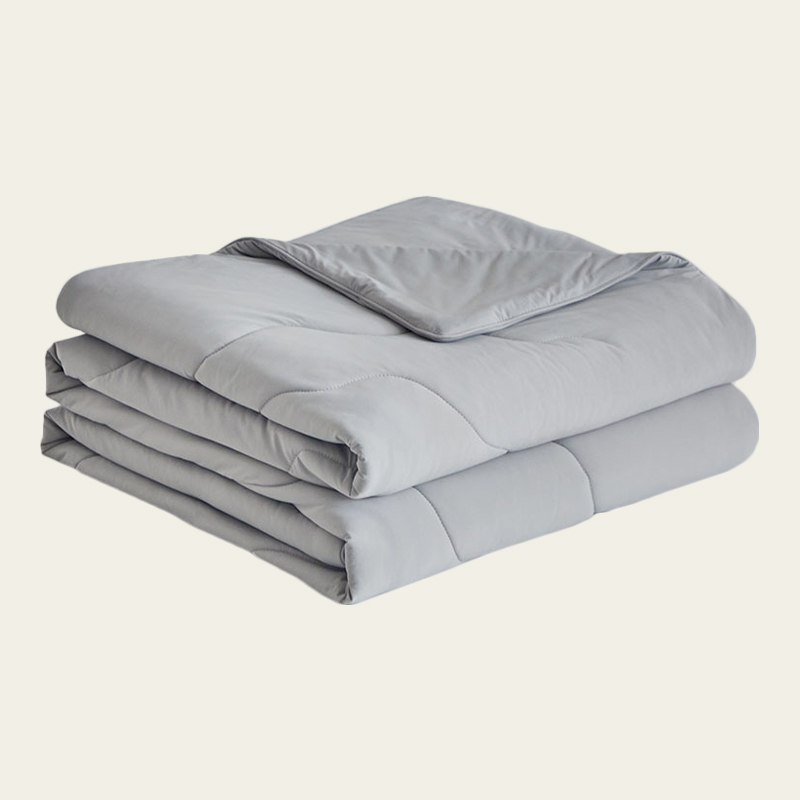
Sewn-Through Quilt Core
Standard stitched construction for light to medium GSM cores.Baffle Box Quilt Core
Internal fabric walls preserve loft for higher-warmth cores.Channel-Stitched Core
Straight stitch channels for a streamlined, tailored look.Double-Layer Quilt Core
Two stacked fill layers for adjustable four-season use.Hybrid Fill Quilt Core
Blended fill materials balancing warmth, cost, and washability.
Key takeaway: selection should start from the target buyer segment and required warmth class, then work backward to fill material, GSM, and stitch construction, rather than starting from a single generic seasonal label.
Fill weight is typically organized into seasonal categories to help buyers and consumers choose the right warmth level without needing to interpret raw GSM figures directly. The stacked bar chart below breaks down an illustrative total GSM figure for four common seasonal categories into two components: the shell fabric weight and the fill weight, since both contribute to the total weight of the finished quilt core even though only the fill weight drives warmth. This distinction matters because two quilt cores with the same total weight can still differ meaningfully in warmth if their shell-to-fill ratio is different. The chart uses generalized figures based on common bedding industry conventions rather than measurements from any specific product line, and actual values will vary by manufacturer and shell fabric selection. Viewing shell and fill weight together also highlights how small the shell fabric's contribution to total weight typically is compared with the fill layer, especially at higher seasonal warmth classes.
Moving from the summer category through to the winter category, total GSM rises substantially, from roughly 150 grams per square meter up to around 515 grams per square meter in this illustrative model, and the fill weight portion accounts for nearly all of that increase. The shell fabric weight, by contrast, stays relatively stable across all four seasonal categories, since shell fabric construction generally does not need to change dramatically to support a heavier fill layer. This is a useful pattern for buyers to understand because it confirms that warmth adjustments across a seasonal product line are driven almost entirely by fill weight decisions rather than shell fabric changes, which simplifies how a quilt manufacturer can plan shell fabric procurement independently of the seasonal fill weight range being produced.
The chart also illustrates why buyers should be cautious about comparing quilt cores purely on total weight without knowing the shell-to-fill ratio. A quilt core with a heavier shell fabric but a lighter fill layer could show a similar total GSM figure to one with a lighter shell and heavier fill, yet the two would feel noticeably different in terms of warmth, since only the fill layer meaningfully affects thermal insulation. For this reason, experienced buyers typically request fill weight and shell fabric weight as separate line items when working with a quilt core supplier, rather than relying on a single combined GSM specification that could be met in more than one way.
Natural fill materials, primarily down, feather, and wool, are often compared directly against synthetic options such as polyester fiberfill and microfiber, since these two broad families represent the main fork in most quilt core sourcing decisions. Neither category is universally better; each carries a distinct set of trade-offs that suit different buyer segments and use cases. The table below summarizes how the two families compare across the factors that most often drive a quilt core sourcing decision.
| Factor | Natural Fill Quilt Core | Synthetic Fill Quilt Core |
|---|---|---|
| Warmth-to-Weight Ratio | Generally higher | Moderate, improving with fiber engineering |
| Breathability | Strong, natural moisture regulation | Good, varies by fiber structure |
| Washability | Lower, requires careful laundering | High, machine washable in most cases |
| Allergy Considerations | Requires processing/cleaning disclosure for sensitive users | Generally suitable for hypoallergenic product lines |
| Typical Applications | Premium tier retail, boutique hospitality | Everyday retail, large-scale hospitality programs |
Loft retention over time is another point worth examining separately from the table above, since it affects long-term product satisfaction rather than initial purchase experience. High-quality down fill tends to recover its loft well after compression, provided it is laundered correctly and given time to fully dry, though repeated improper washing can degrade this recovery over the product's lifespan. Synthetic fibers, particularly modern engineered polyester fiberfill, have narrowed this gap considerably, with many current products achieving loft recovery rates that approach natural fill performance while retaining the washability advantage that makes synthetic fill the practical choice for high-turnover hospitality and retail programs.
Buyers often assume that thermal warmth increases in direct proportion to fill weight, but the actual relationship follows a curve rather than a straight line. The area chart below illustrates the general pattern between fill weight, measured in GSM, and an illustrative thermal insulation value, using a simplified clo-style rating scale commonly referenced in textile insulation discussions. This pattern reflects generalized fill behavior rather than a specific tested product, and actual insulation values depend on fill material, loft, and stitch construction as much as on GSM alone. The key feature to notice is that insulation value rises quickly at lower GSM values and then gradually flattens as GSM continues to increase, similar in shape to diminishing-returns patterns seen elsewhere in textile and materials engineering. Understanding this curve helps buyers avoid over-specifying fill weight when a more moderate GSM would deliver nearly the same warmth at a lower total product weight.
In the lower GSM range, roughly between 100 and 300 grams per square meter on the illustrative curve, insulation value increases quickly with each additional increment of fill weight, which is the range most lightweight and mid-season quilt cores fall into. As GSM continues to climb past 300, the rate of insulation gain per additional gram slows noticeably, and by the time the curve approaches 500 GSM, further weight increases add comparatively little additional warmth. This flattening effect happens because insulation depends heavily on trapped air within the loft structure, and beyond a certain fill density, additional material compresses the existing air pockets rather than creating meaningfully more insulating volume.
This pattern has direct implications for product planning. A buyer targeting a genuine winter-weight product does not necessarily need to push GSM to the highest available figure, since the insulation gain beyond a certain point becomes small relative to the added weight, cost, and bulk of the finished quilt. Instead, many experienced buyers work with their quilt core manufacturer to identify the GSM range that sits just past the steepest part of the curve, capturing most of the available insulation benefit without unnecessary added weight. This same reasoning also explains why loft-optimized fill materials, such as down or well-engineered synthetic fiberfill, can achieve a given warmth target at a lower GSM than denser materials like cotton, since their fiber structure creates more trapped air per gram of fill.
How well a quilt core's fill recovers its loft after being compressed, whether from storage, shipping, or repeated washing, is an important long-term performance factor that is easy to overlook during initial sourcing. The three progress rings below present an illustrative loft recovery rate comparison across polyester fiberfill, cotton fill, and down and feather blend, each expressed as an approximate percentage of original loft regained after standard compression testing. These figures are drawn from general fiber behavior patterns commonly discussed in textile engineering literature rather than results from a specific tested batch, and actual recovery rates vary with fiber quality, processing method, and care practices. The comparison is most useful for understanding the relative ordering between fill types rather than for citing an exact recovery percentage for any specific product. Loft recovery matters most for products that will be compressed repeatedly during their service life, such as folded hotel bedding stock or vacuum-packed shipping formats.
Down and feather blend shows the highest illustrative loft recovery rate among the three materials compared, which aligns with the natural cluster structure of down fibers, which spring back into their three-dimensional shape efficiently after compression as long as they remain dry and undamaged. Polyester fiberfill sits in the middle of the comparison, reflecting steady improvement in fiber engineering over recent years, with many current synthetic fibers using crimped or hollow structures specifically designed to improve compression recovery compared with older, simpler fiber constructions. Cotton fill shows the lowest illustrative recovery rate of the three, which is consistent with cotton's denser, less springy fiber structure, and is one reason cotton-filled cores are more commonly recommended for flat storage rather than repeated compression or vacuum-packed shipping formats.
For hospitality buyers and OEM brands planning storage, shipping, and inventory rotation practices, this comparison offers a practical planning input beyond the initial feel of the product at the point of sale. A quilt core with strong loft recovery holds up better through the compressed storage and shipping cycles common in bulk hospitality procurement and e-commerce fulfillment, while a lower-recovery material may need more careful handling guidance to preserve its appearance and warmth over repeated use. Buyers working with a quilt core supplier on a large hospitality or private-label order often find it worthwhile to ask directly about recovery behavior for their selected fill material, particularly if the finished product will be vacuum-packed or tightly folded during distribution.
Proper care extends the useful life of a quilt core regardless of fill material, and how a product is washed, dried, and stored has a measurable effect on how well it retains loft and warmth over time. The steps below apply broadly across fill types, with additional caution recommended for natural fill materials as noted.
Key takeaway: most loft loss in a quilt core develops gradually through repeated compression and improper washing, so a consistent, fill-appropriate care routine is generally the most effective way to preserve warmth and appearance over the product's service life.
Demand for down-alternative fill materials has generally trended upward across the bedding industry in recent years, as more brands and hospitality buyers look for products that combine strong warmth and hand-feel with straightforward washability. This shift has encouraged wider adoption of engineered microfiber and advanced polyester fiberfill constructions, moving these materials from a lower-tier alternative toward a genuine mid-to-premium product category in many catalogs. At the same time, buyers continue to expect fill material, GSM, and stitch construction to be specified together as a coordinated package rather than purchased as loosely defined generic components, which has encouraged closer collaboration between bedding brands and their quilt core manufacturer partners during product development.
Manufacturers such as Nantong Yueluo Home Furnishings Co., Ltd. illustrate how this kind of specification-first, full-catalog approach has developed within the industry. Established in 2008, the company has long been committed to the production and innovation of a full range of bedding products, including bedding cores, kits, and mattresses, offering comprehensive solutions under one roof. Operating as a source factory, it maintains complete production and testing equipment alongside a scientific quality management system, an operational profile that reflects how established quilt core suppliers increasingly support multiple bedding categories rather than a single narrow product line. This kind of integrated manufacturing background, paired with carefully selected materials and attentive craftsmanship, is generally a useful reference point for buyers comparing potential quilt core wholesaler partners for a new or expanding bedding program, alongside the technical selection factors covered earlier in this guide.
Looking ahead, several practical trends are worth watching for bedding buyers and product developers. Interest in hybrid fill constructions, blending two or more fill materials within a single quilt core, continues to grow as brands look for ways to balance warmth, cost, and washability without committing entirely to one material family. Standardized GSM and stitch density labeling is also becoming more common on product specification sheets, supporting the kind of precise, coordinated ordering approach described throughout this guide. Buyers evaluating a quilt manufacturer for a new private-label program increasingly ask about hybrid fill options and detailed construction documentation alongside traditional questions about fill material and warmth class, reflecting a broader shift toward treating the quilt core as a precisely engineered component rather than a loosely specified commodity item.
Q1: What is the difference between a quilt core and a finished quilt?A finished quilt is the complete bedding item, including its outer cover or shell fabric and any decorative finishing. The quilt core is the inner fill layer and construction assembly, the component that determines warmth, weight, and loft, and it is often supplied separately to brands that add their own cover fabric or design. |
Q2: How is quilt core warmth actually measured or described?Warmth is generally described through fill weight in GSM combined with fill material and loft, rather than a single universal warmth number. Buyers comparing options from different suppliers typically request GSM, fill material, and stitch construction together to make an accurate warmth comparison. |
Q3: Is a higher GSM always warmer than a lower GSM quilt core?Generally yes, but the relationship follows a curve rather than a straight line, with insulation gains slowing at higher GSM values, as shown in the fill weight and insulation chart earlier in this guide. Fill material and loft also affect warmth independently of GSM alone. |
Q4: What is baffle box construction and when is it used?Baffle box construction uses internal fabric walls to create individual chambers for the fill, keeping it fully lofted rather than compressed at stitch lines. It is generally used for higher-loft, higher-warmth quilt cores where preserving maximum fill thickness is a priority. |
Q5: Can a quilt core supplier produce custom fill weight and stitch patterns for a private-label order?Many quilt core manufacturers offer customization of fill material, GSM, and stitch pattern for bulk or private-label orders. Buyers typically discuss target warmth class, order volume, and finishing requirements directly with the supplier to confirm what customization options are available for a specific program. |
 Zhihao Industrial Park, Chuanjiang Town, Tongzhou District, Nantong, Jiangsu Province
 +86-13814711705
 yueluo800@163.com
Copyright © Nantong Yueluo Home Furnishings Co., Ltd
Rights Reserved.